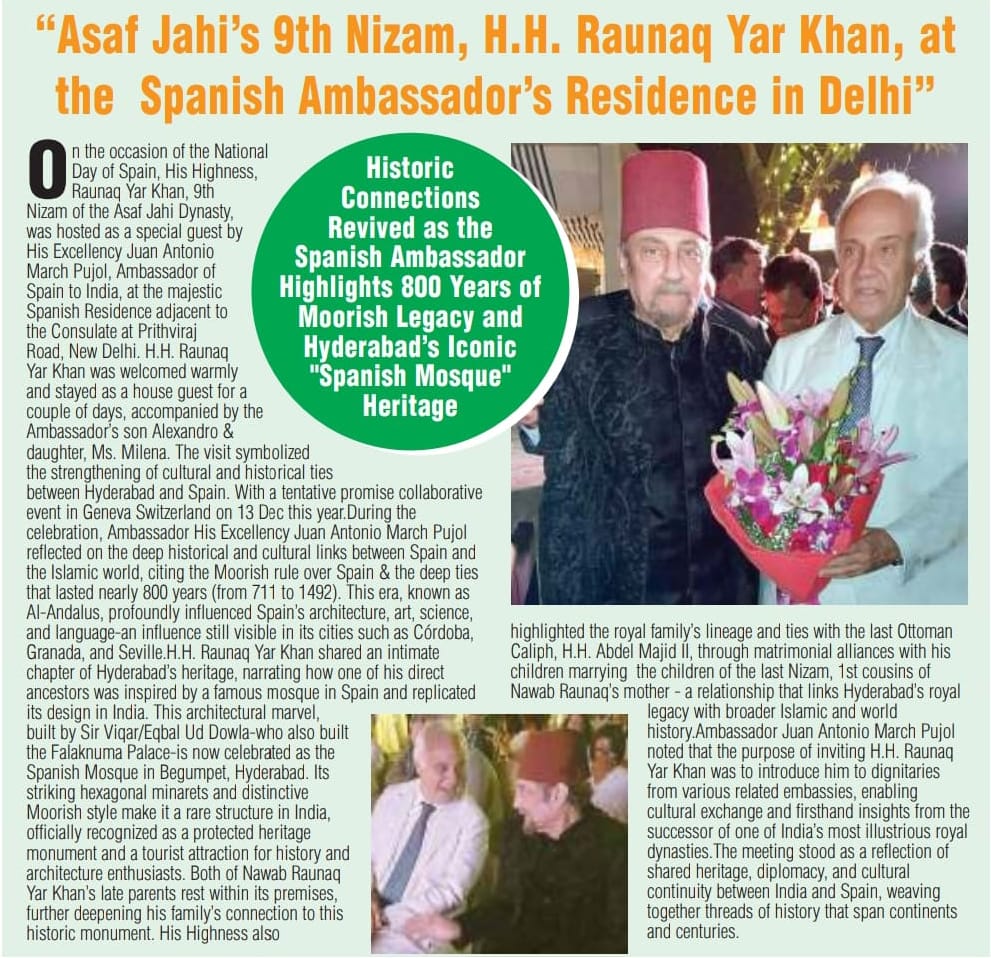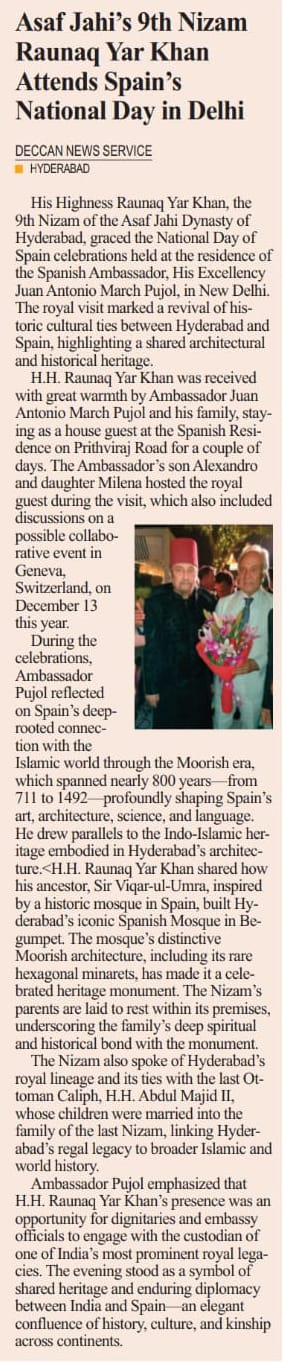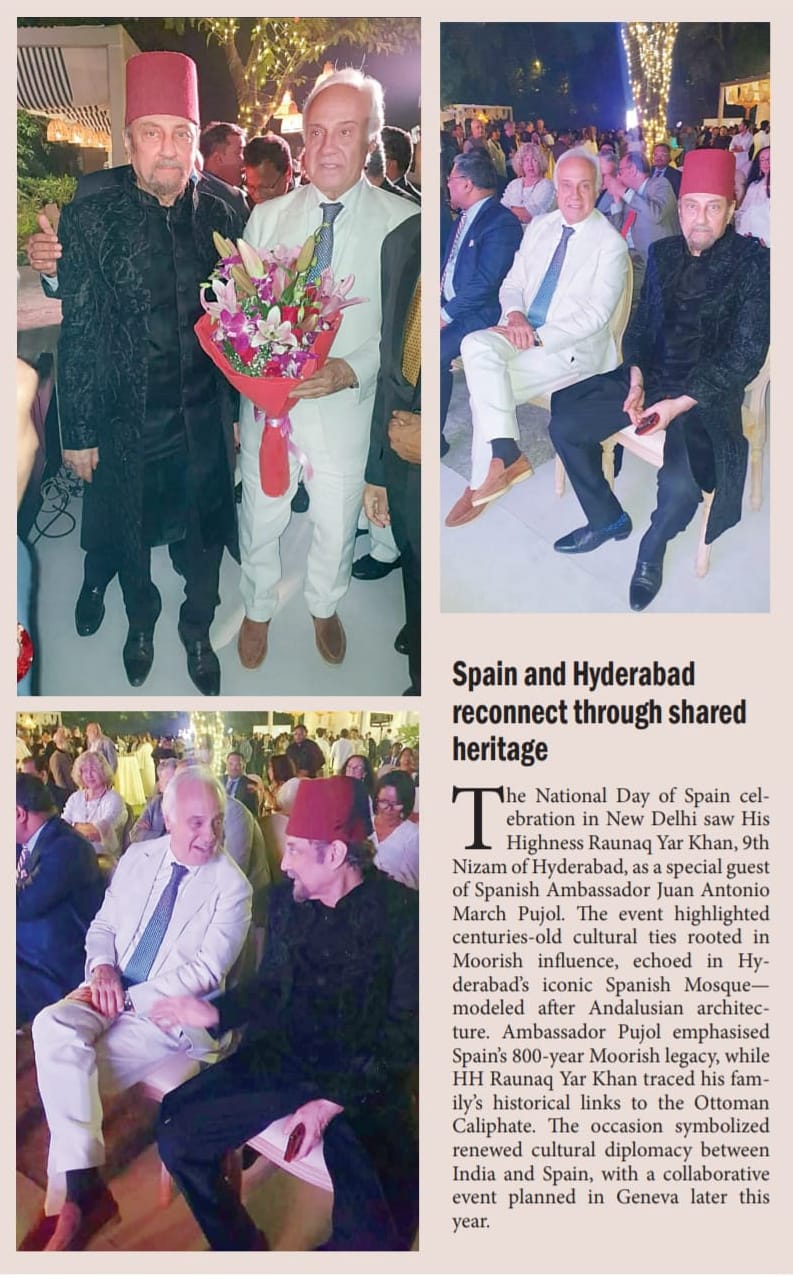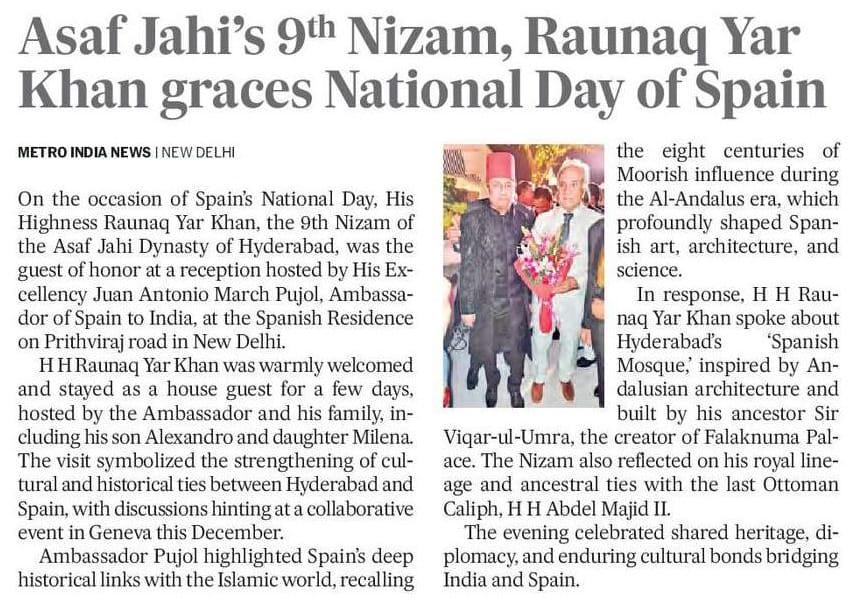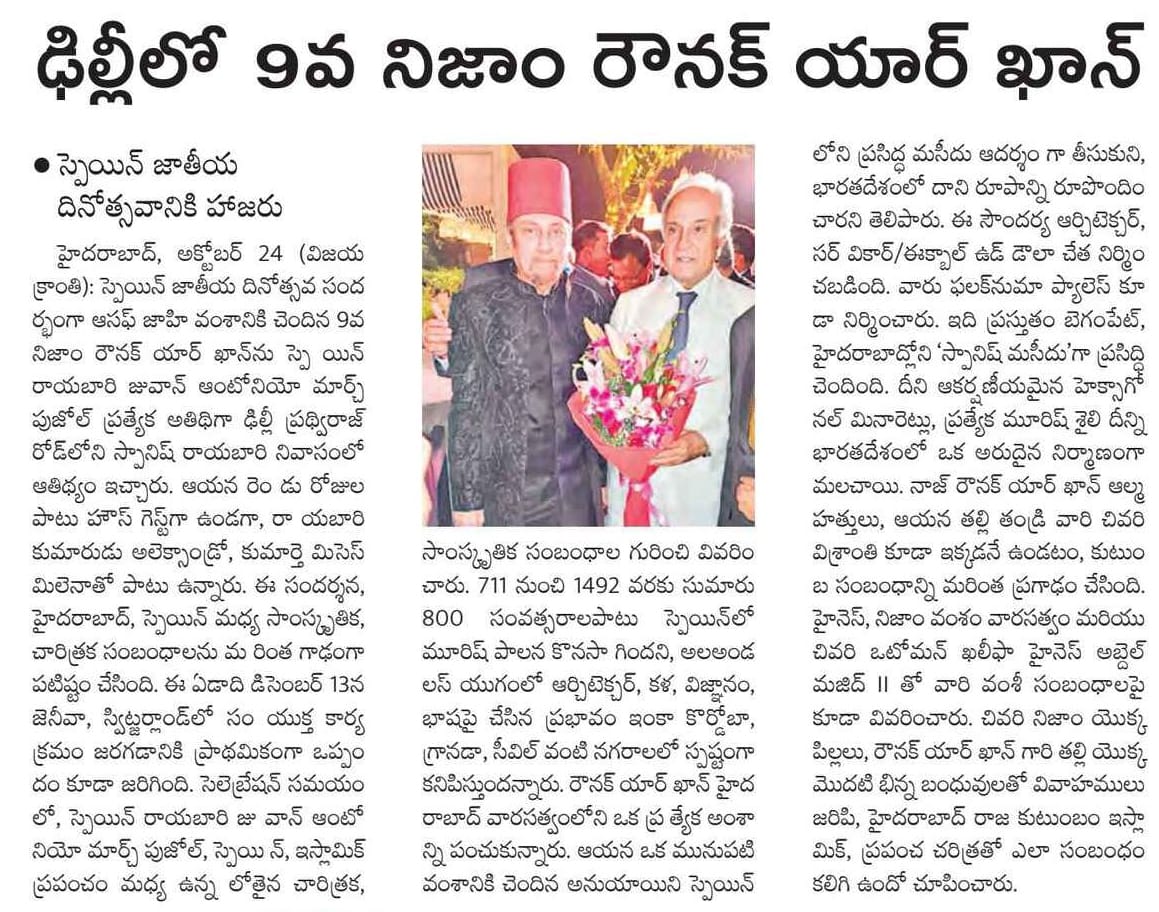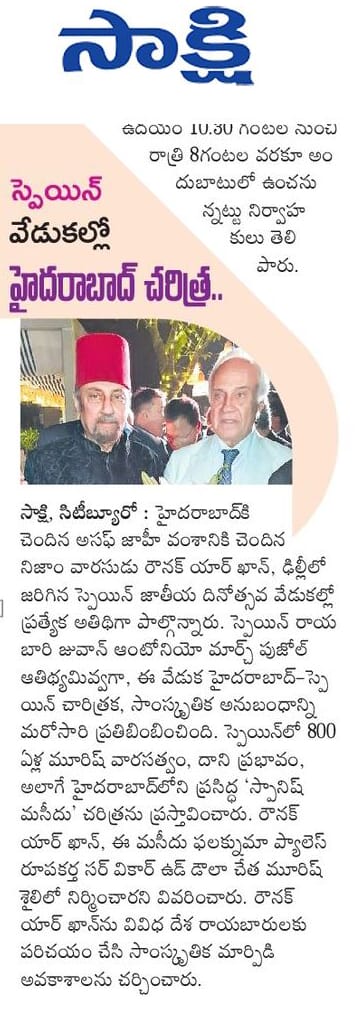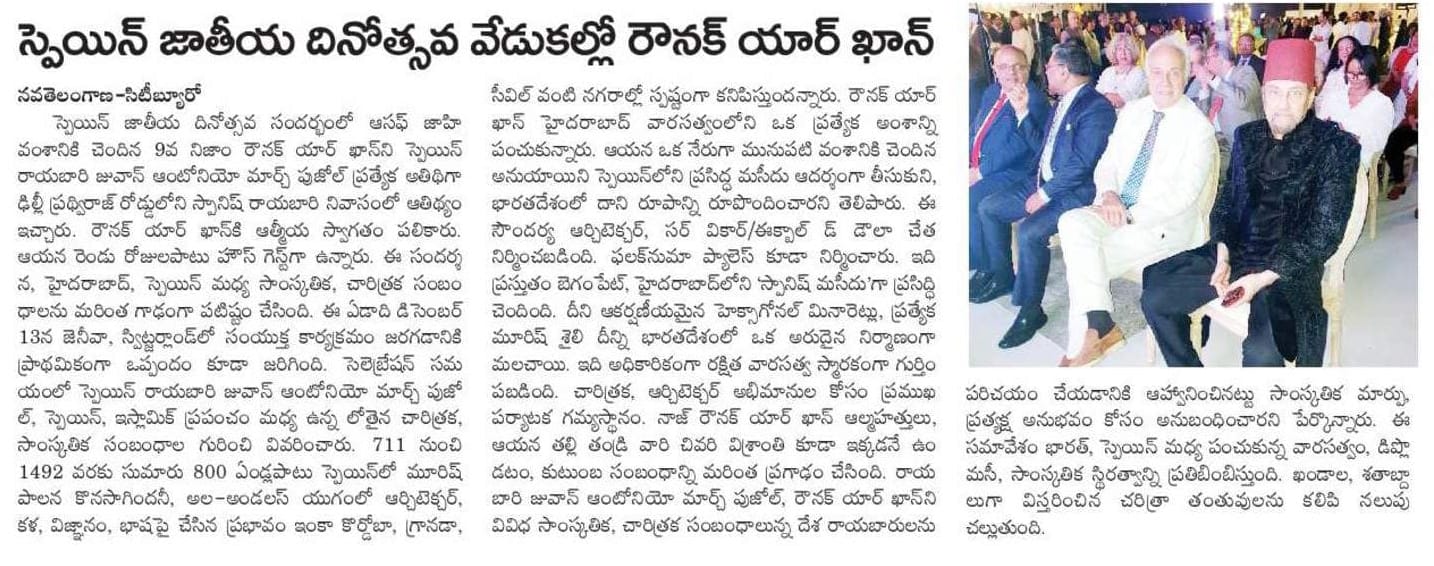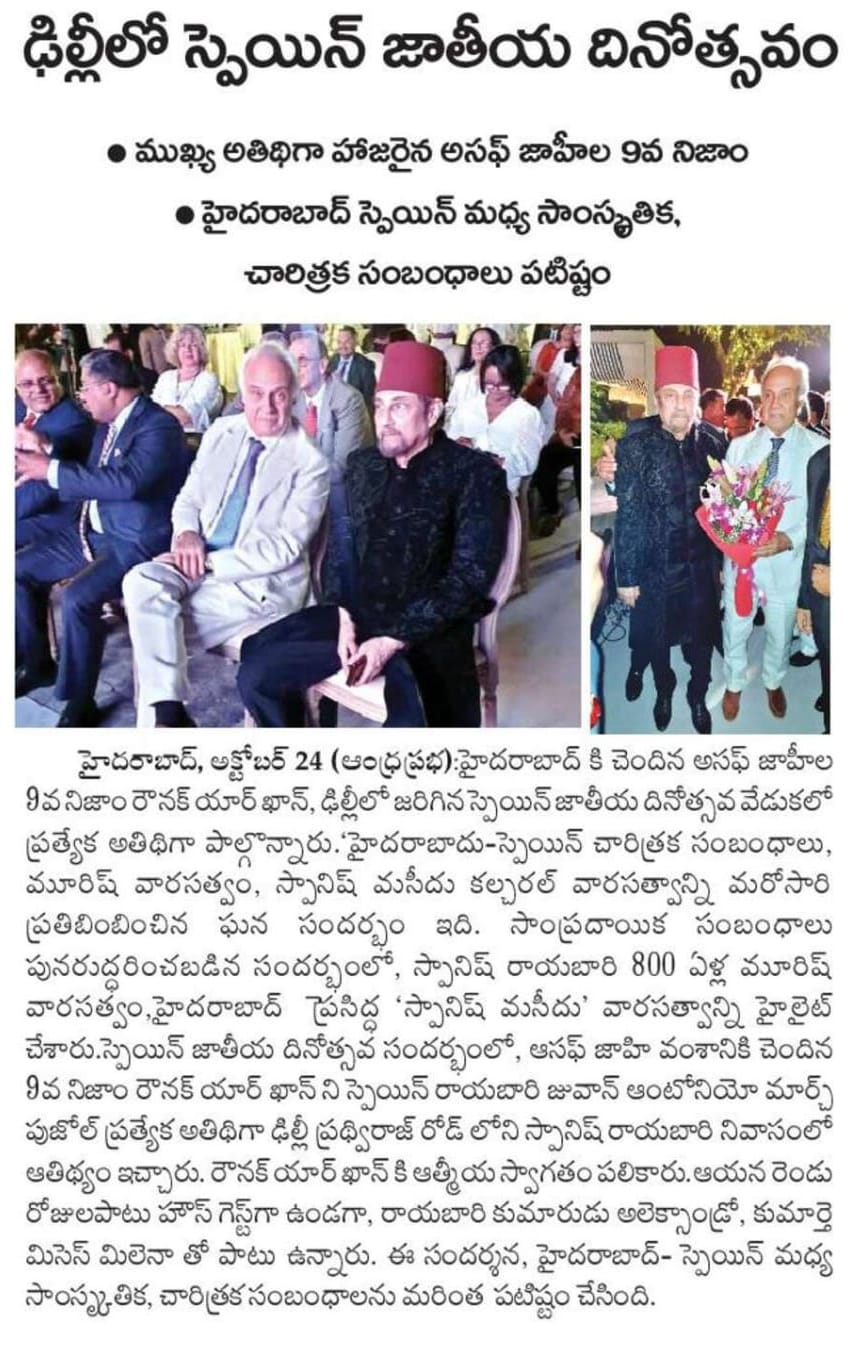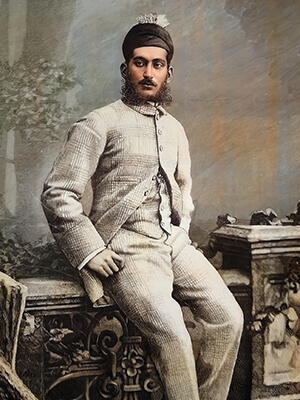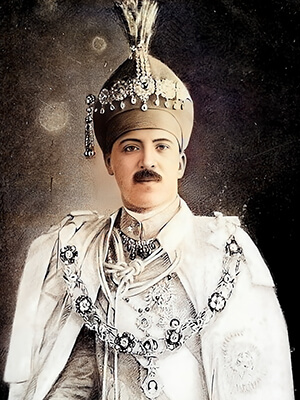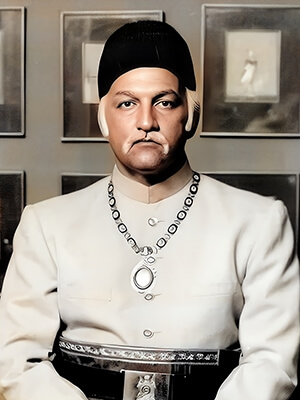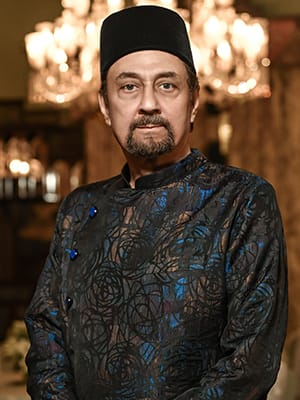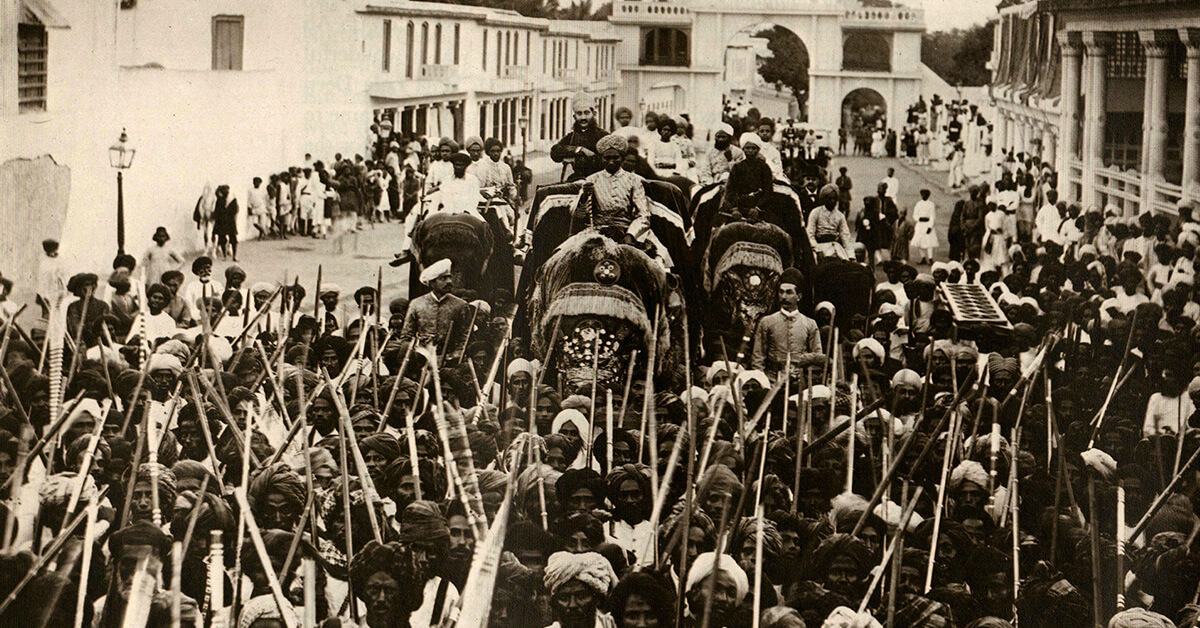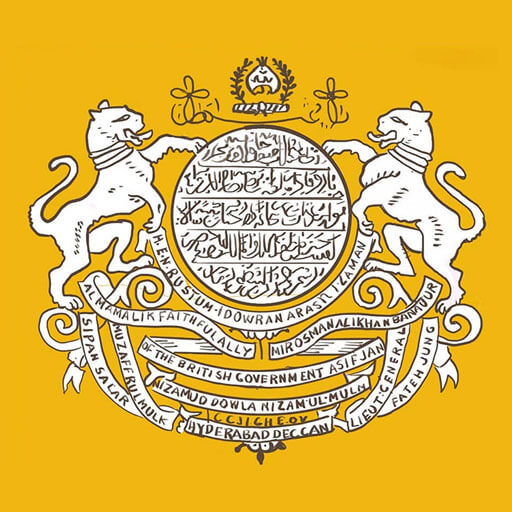

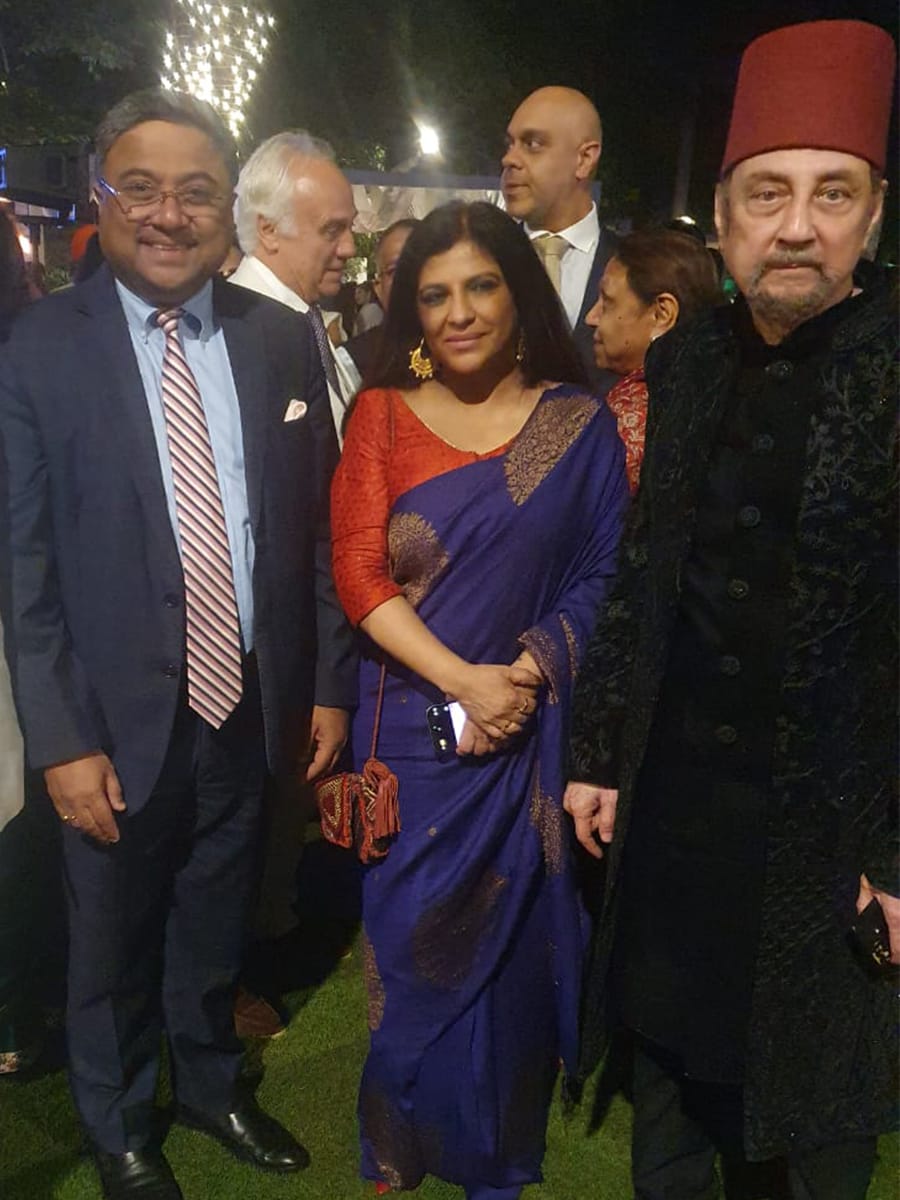
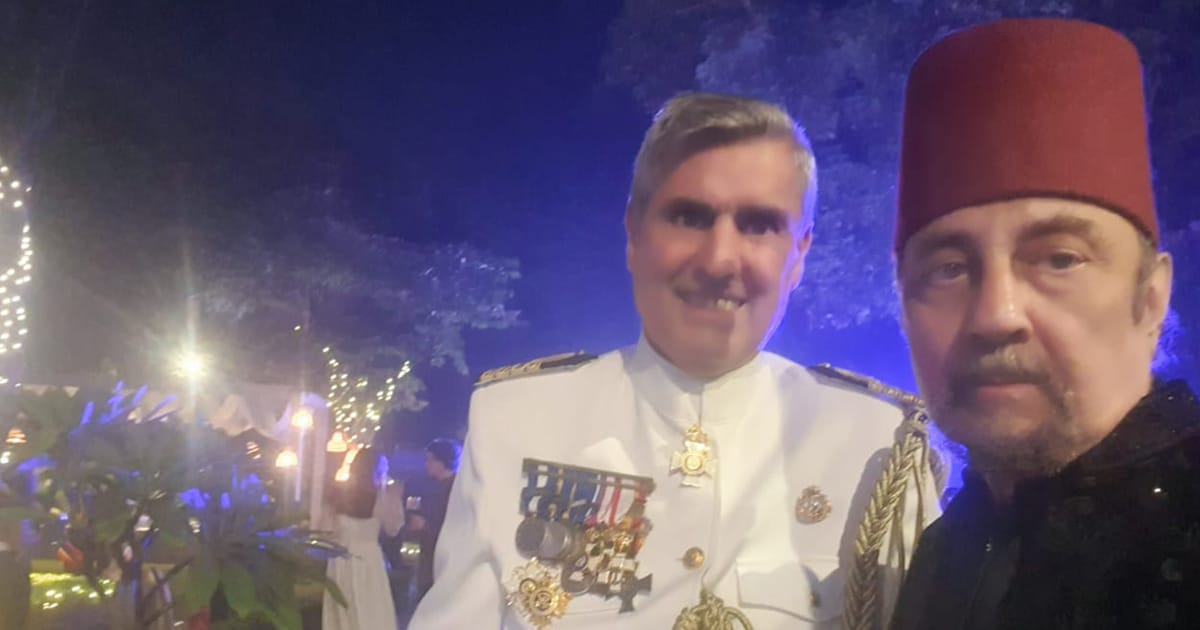
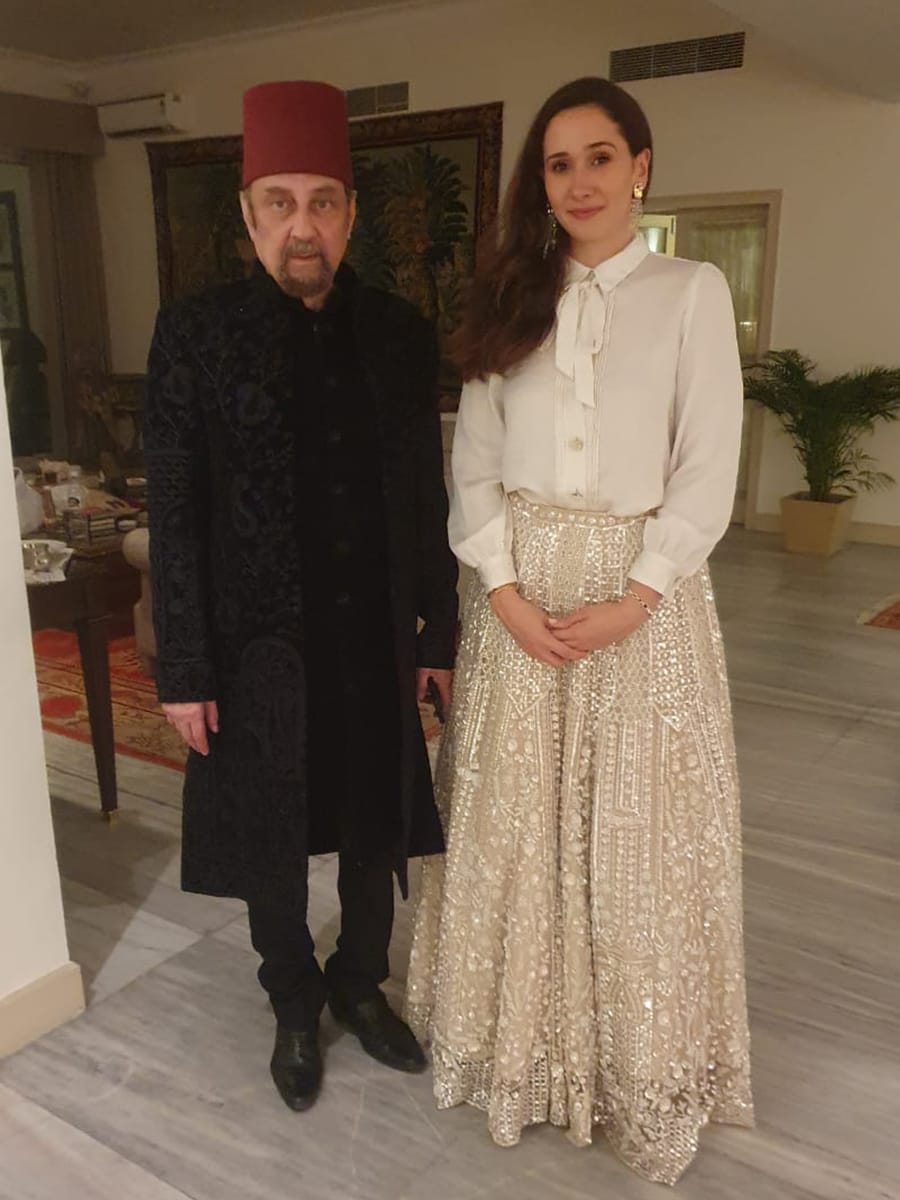
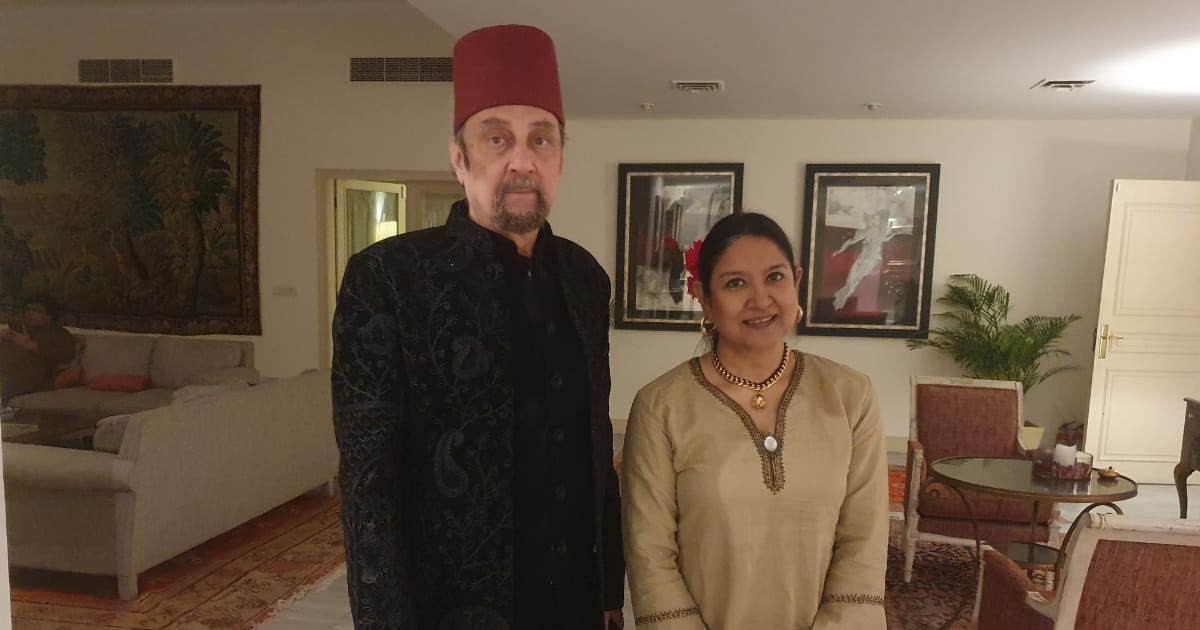
Upon the auspicious occasion of the National Day of Spain – a day resplendent with the echoes of Iberian grandeur and the spirit of a nation shaped by centuries of cultural confluence – His Highness Nawab Raunaq Yar Khan, the IX Nizam of the illustrious Asaf Jahi Dynasty, was received with the utmost reverence and hospitality at the distinguished residence of His Excellency Juan Antonio March Pujol, Ambassador of Spain to India. Nestled adjacent to the Spanish Consulate on the verdant expanse of Prithviraj Road in New Delhi, this residence became the stage upon which history and diplomacy intertwined, weaving together narratives of shared heritage, cultural continuity, and the enduring bonds between the Deccan and distant Iberia.
The warmth with which His Highness was welcomed spoke volumes of the esteem in which the Asaf Jahi lineage is held across the world. For a span of two days, Nawab Raunaq Yar Khan remained as a cherished house guest, his stay enriched by the gracious companionship of Ambassador Pujol’s children – his son Alexandro and daughter Ms. Milena. In the halls adorned with Spanish artistry and amid conversations that traversed centuries of civilization, there emerged a vision of collaboration and cultural dialogue, culminating in a tentative pledge to convene a distinguished gathering in Geneva, Switzerland, on the 13th of December this year. Such an endeavour, should it come to fruition, would serve as yet another testament to the IX Nizam’s commitment to fostering international understanding and celebrating the rich history that unite disparate lands.
The Historical Confluence of Al-Andalus and the Spanish Soul
During the celebrations marking Spain’s National Day, Ambassador Juan Antonio March Pujol delivered reflections steeped in historical profundity, drawing attention to the deep and abiding connections between Spain and the Islamic world. His words conjured the splendour of Al-Andalus, that luminous epoch spanning nearly eight centuries – from the year 711 to 1492 – when Moorish rule bestowed upon the Iberian Peninsula a legacy of unparalleled cultural and intellectual achievement. Under the aegis of the Umayyad Caliphate and subsequent Muslim dynasties, Spain became a crucible of learning, art, and architectural magnificence, its cities transformed into jewels of civilization.
Córdoba, with its breathtaking Mezquita, a mosque-cathedral that stands as a symphony in stone and light, epitomizes the architectural genius of that era. Granada’s Alhambra, with its intricate arabesques and serene courtyards, remains a monument to the aesthetic sensibilities of the Nasrid dynasty. Seville, too, bears the indelible imprint of Islamic influence, its Giralda tower originally serving as a minaret before being incorporated into the cathedral. The Moorish presence enriched Spanish language, science, philosophy, and the arts, leaving a legacy that continues to resonate through the cobblestone streets and sun-drenched plazas of contemporary Spain.
It is within this context of shared heritage and cultural cross-pollination that the presence of His Highness Nawab Raunaq Yar Khan at the Spanish Residence assumes profound significance. The IX Nizam, as the custodian of a dynasty that itself has been a beacon of Islamic culture and refinement in the Indian subcontinent, embodies the very continuity of traditions that Ambassador Pujol so eloquently invoked. The Asaf Jahi Dynasty, renowned for its patronage of art, architecture, and scholarship, mirrors the enlightened governance that characterized the golden age of Al-Andalus.
An Architectural Echo: From Spain to Hyderabad
Amidst the convivial exchanges and reflections upon history, His Highness Nawab Raunaq Yar Khan shared a narrative of exquisite intimacy and historical resonance – a tale that bridges the Mediterranean and the Deccan, linking the architectural splendours of Spain with the rich heritage of Hyderabad. He recounted how one of his distinguished forebears, moved by the sublime beauty of a celebrated mosque in Spain, endeavoured to replicate its design upon the soil of Hyderabad, thereby creating an enduring monument to cross-cultural admiration and artistic inspiration.
This architectural marvel was conceived and brought to fruition by Sir Viqar-ul-Mulk Eiqbal Ud Dowla, a nobleman of great vision and refinement, whose contributions to Hyderabad’s urban and cultural landscape remain unparalleled. Sir Viqar-ul-Mulk is perhaps best known as the architect behind the Falaknuma Palace, that resplendent edifice perched upon a hill, whose name translates to “Mirror of the Sky” – a fitting appellation for a structure that seems to hover between earth and the heavens. Yet his legacy extends beyond this singular masterpiece, encompassing the creation of what is now affectionately and officially known as the Spanish Mosque, situated in Begumpet, Hyderabad.
The Spanish Mosque, with its distinctive hexagonal minarets and unmistakable Moorish architectural style, stands as a rare and precious jewel within the Indian subcontinent. Its design, characterized by elegant arches, intricate tilework, and a harmonious blending of form and function, evokes the spirit of Al-Andalus while being firmly rooted in the cultural milieu of Hyderabad. The mosque’s striking silhouette, with minarets that rise gracefully towards the sky, serves as a visual testament to the aesthetic dialogue between two distant yet spiritually connected civilizations.
Officially recognized as a protected heritage monument, the Spanish Mosque attracts visitors from across the globe – historians, architects, and enthusiasts of Islamic art and culture who seek to witness firsthand this unique synthesis of Spanish and Deccani architectural traditions. For His Highness Nawab Raunaq Yar Khan, this monument holds a significance that transcends its historical and aesthetic value. It is a deeply personal site, for within its precincts rest the mortal remains of both his late parents, rendering it a sacred space imbued with familial memory and spiritual resonance. This connection deepens the IX Nizam’s commitment to preserving and celebrating the heritage of his ancestors, ensuring that future generations may continue to draw inspiration from their legacy.
Lineage, Legacy, and the Bonds of Islamic History
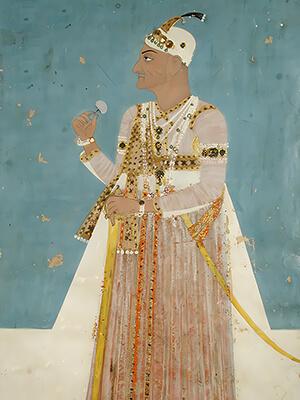
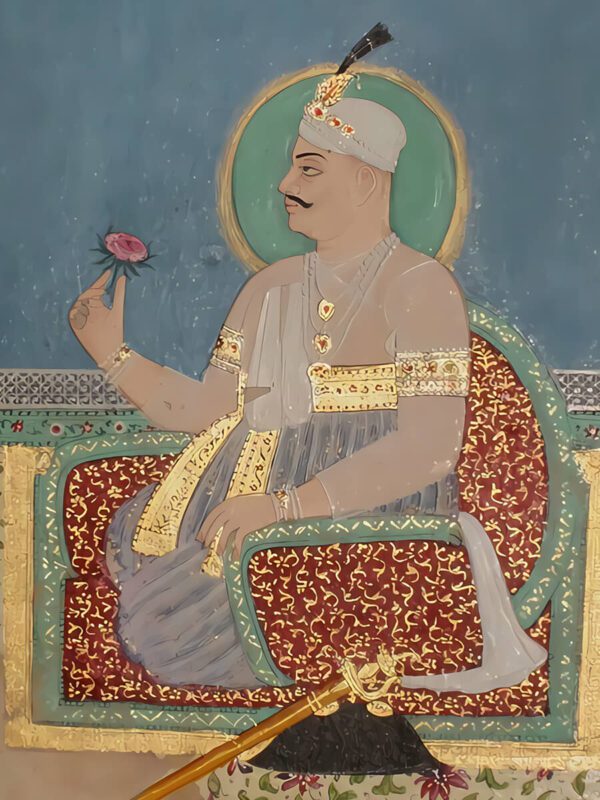
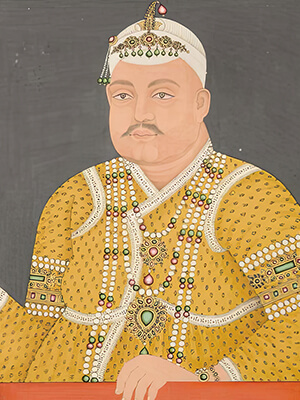
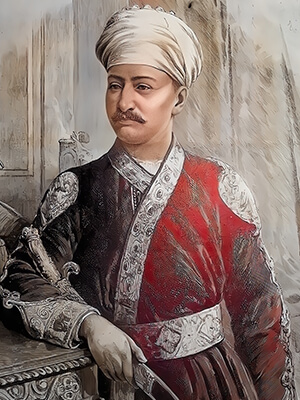
The IX Nizam’s visit to the Spanish Residence also provided an occasion to illuminate the illustrious lineage and far-reaching connections of the Asaf Jahi Dynasty, which extend well beyond the borders of the Deccan. His Highness spoke with pride of the royal family’s ties with the last Ottoman Caliph, His Highness Abdel Majid II, a relationship forged through matrimonial alliances that linked the progeny of the Caliphate with those of the VII Nizam of Hyderabad. These unions, which saw the children of the last Ottoman Caliph marrying the children of the last recognized Nizam, were not merely dynastic arrangements but symbolic expressions of solidarity and shared heritage within the broader Islamic world.
The first cousins of Nawab Raunaq Yar Khan’s mother were among those who participated in these historic unions, thereby intertwining the destinies of the Asaf Jahi and Ottoman lineages. Such connections underscore the cosmopolitan character of Hyderabad’s royal family, whose reach and influence extended across continents, encompassing the cultural and political spheres of the Islamic world. The Ottoman Caliphate, as the last great Islamic empire, represented a continuity of spiritual and temporal authority that resonated deeply with the Muslim elite of the subcontinent. The ties between Hyderabad and Istanbul thus signified more than familial bonds; they were expressions of a shared commitment to the preservation and promotion of Islamic culture, learning, and values.
The Nizams of Hyderabad were not provincial rulers confined to the Deccan; they were figures of international stature, whose patronage of arts and sciences, whose diplomatic acumen, and whose commitment to the welfare of their subjects earned them recognition and respect across the globe. The recognition bestowed upon Nawab Raunaq Yar Khan by the Majlis-E-Sahebzadegan Society (MESS) – a body representing approximately 4,500 direct descendants of the first six Nizams and the nobles of the dynasty – on the 2nd of March, 2023, at the historic Khaja Ka Chilla in Moghalpura, further solidifies his role as the custodian of this illustrious heritage.
Diplomacy, Cultural Exchange, and the Vision of the IX Nizam
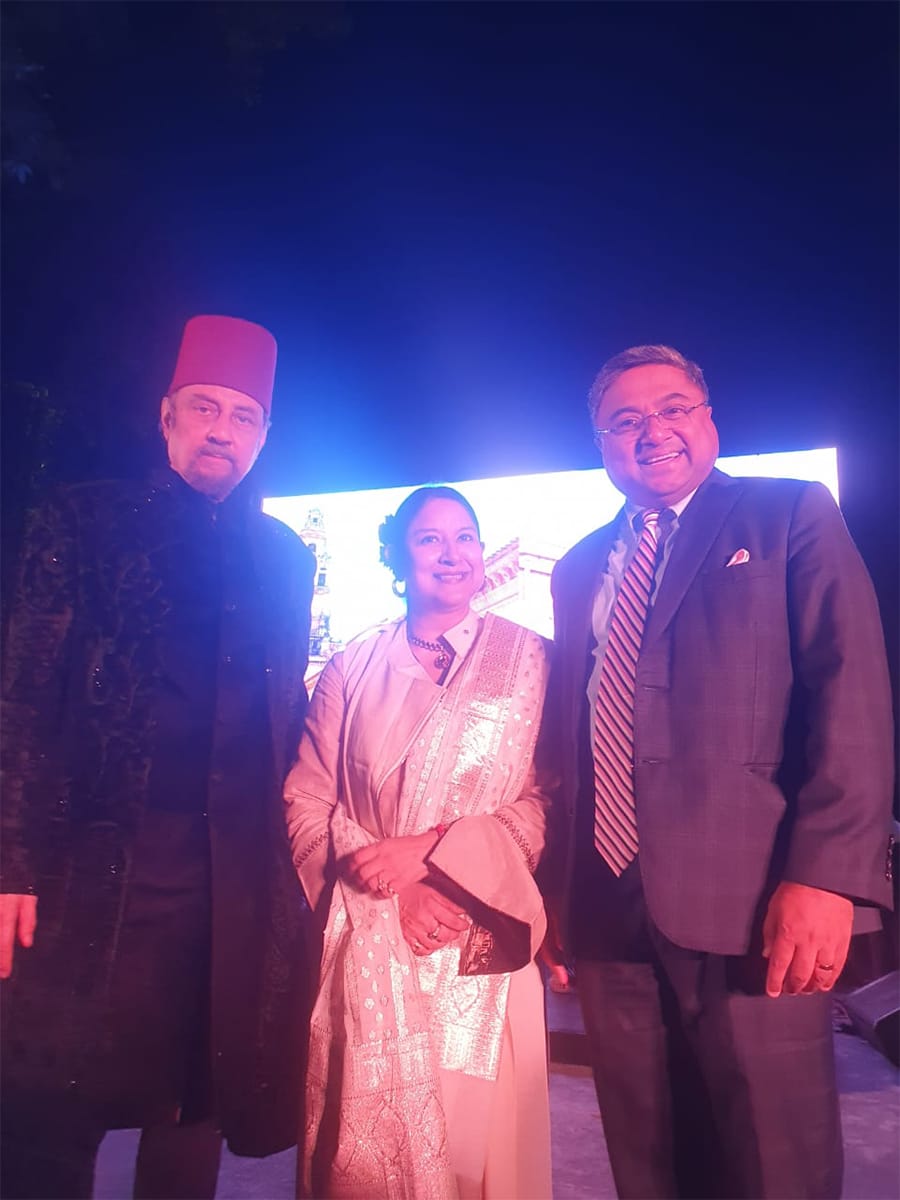
Ambassador Juan Antonio March Pujol articulated with clarity the purpose underlying the invitation extended to His Highness Nawab Raunaq Yar Khan. Beyond the courtesies of diplomatic protocol and the convivial atmosphere of the National Day celebrations, the Ambassador sought to facilitate a meaningful introduction between the IX Nizam and dignitaries representing various embassies and cultural institutions. Such introductions serve to foster cultural exchange, enabling firsthand insights into the heritage and legacy of one of India’s most distinguished royal dynasties. The IX Nizam’s presence at the Spanish Residence thus became a conduit for dialogue, a meeting point where the historical narratives of different civilizations could intersect and enrich one another.
In an era where globalization often threatens to homogenize cultures and erase the particularities of regional traditions, the IX Nizam’s role as a cultural ambassador assumes heightened importance. His commitment to preserving the heritage of the Asaf Jahi Dynasty, to maintaining the traditions and values that have defined his lineage for centuries, stands as a counterpoint to the forces of cultural erasure. Yet this commitment is not rooted in a desire for isolation or insularity; rather, it is expressed through engagement, through dialogue, and through the forging of connections that honour the past while embracing the possibilities of the future.
The tentative plans for a collaborative event in Geneva on the 13th of December represent a concrete manifestation of this vision. Geneva, as a hub of international diplomacy and cultural exchange, provides an ideal venue for an event that celebrates the shared heritage of the Islamic world and the broader human community. Whether through exhibitions of art and architecture, scholarly symposia, or cultural performances, such an event would serve to illuminate the contributions of the Asaf Jahi Dynasty to the cultural and intellectual life of the subcontinent and beyond. It would also provide an opportunity for contemporary audiences to engage with a history that is too often overlooked or misunderstood, fostering a deeper appreciation for the richness and diversity of India’s royal and cultural heritage.
Shared Heritage, Diplomacy, and the Future
The meeting at the Spanish Residence on the occasion of Spain’s National Day stands as a reflection of shared heritage, diplomacy, and cultural continuity. It brought together representatives of two nations whose histories, though geographically distant, are interwoven through the threads of Islamic civilization and cultural exchange. The conversations that unfolded within those halls – touching upon Al-Andalus, the architectural wonders of Hyderabad, the Ottoman Caliphate, and the possibilities for future collaboration – underscored the enduring relevance of history in shaping contemporary relationships.
Ambassador Juan Antonio March Pujol’s reflections on the Moorish legacy in Spain resonated deeply with His Highness Nawab Raunaq Yar Khan’s narrative of the Spanish Mosque in Hyderabad. Both stories speak to the capacity of human beings to transcend the limitations of geography and time, to create works of beauty and meaning that honour diverse traditions while forging new connections. In an age where the rhetoric of division often dominates public discourse, such stories offer a powerful counternarrative – one that celebrates the richness of cultural plurality and the potential for mutual understanding.

Weaving Together the Threads of History
The visit of His Highness Nawab Raunaq Yar Khan, the IX Nizam of the Asaf Jahi Dynasty, to the Spanish Residence in New Delhi was far more than a ceremonial occasion. It was a moment of historical and cultural significance, a meeting that bridged continents and centuries, linking the splendours of Al-Andalus with the heritage of Hyderabad, the legacy of the Ottoman Caliphate with the enduring traditions of the Deccan. Through his engagement with Ambassador Juan Antonio March Pujol and other dignitaries, the IX Nizam demonstrated the continuing relevance of royal lineages as custodians of cultural memory and as facilitators of international dialogue.
As the IX Nizam continues to fulfil his symbolic and cultural role, his engagements—whether in New Delhi, in Geneva, or closer to home in Hyderabad – serve to illuminate the richness of the Asaf Jahi legacy. They remind us that history is not a static repository of facts and dates but a living, breathing presence that shapes our understanding of ourselves and our place in the world. Through his efforts to foster cultural exchange, to preserve architectural and artistic heritage, and to honour the bonds that connect diverse civilizations, His Highness Nawab Raunaq Yar Khan embodies the values of his ancestors while charting a course for the future—a future in which the threads of history are woven together to create a tapestry of shared humanity, mutual respect, and enduring cultural continuity.
In Media