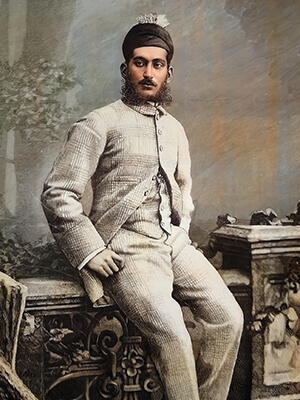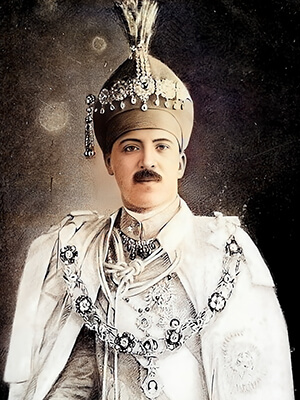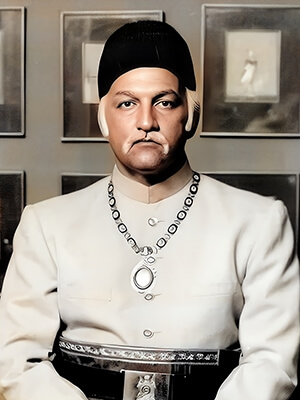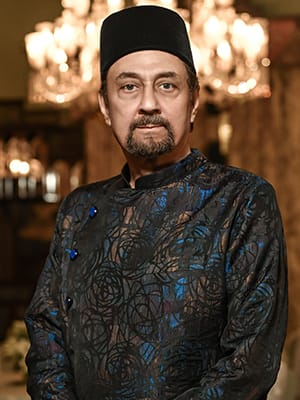
For decades, Hyderabad’s Princess Esra was regarded as the custodian of a fading royal legacy – the woman credited with restoring Nizam-era palaces and reviving the city’s aristocratic past. More visible than her former husband, the titular eighth Nizam Mukarram Jah, who died in 2023, Esra wore many hats. She ran the Nizam family’s Chowmahalla Palace, facilitated the lease of Falaknuma to the Taj Group, and re-established a royal presence in a city that had long moved on politically. Until now, her public image in Hyderabad has remained largely intact.
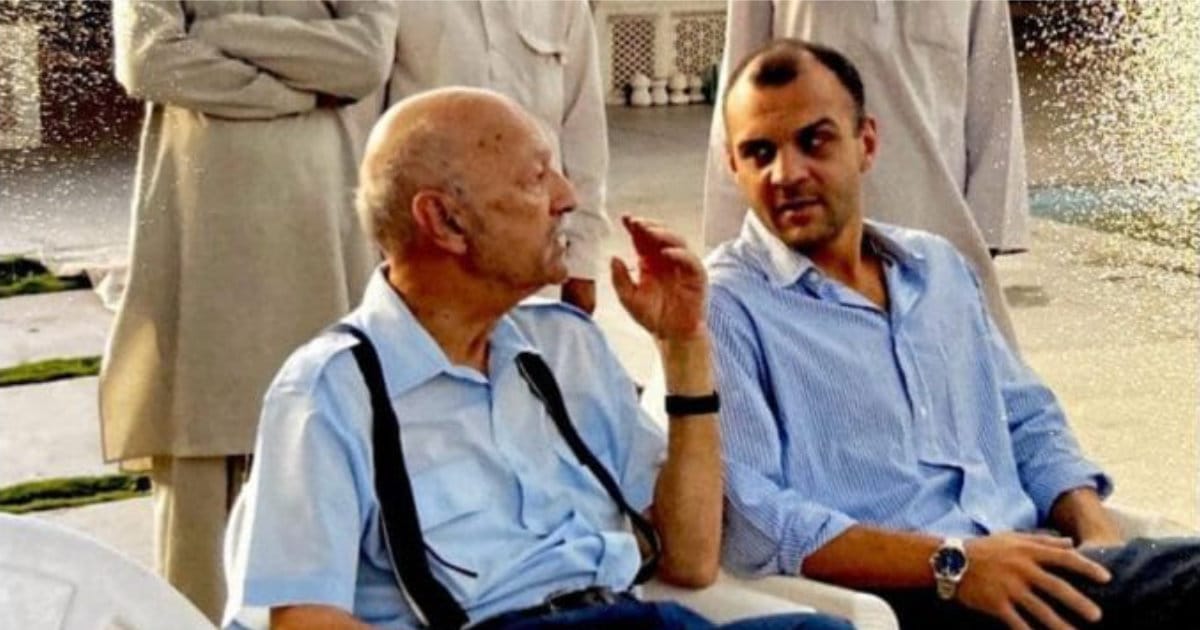
It began to fray after Mukarram Jah’s son, Prince Alexander Azam Jah Bahadur, has stepped into the public eye as a simmering inheritance battle spills into court. At stake are not just estates and control over the Nizam’s vast assets, but access to a childhood world Azam Jah says he has been shut out of and denied – palaces he grew up in, his father’s jackets and even Qurans that once belonged to him.
In an exclusive interview with ThePrint, he alleges that his stepmother, 89-year-old Esra, exercised near-total control over Mukarram Jah’s life and final years, shaping both the estates and the story told about them, dragging into the open a royal feud Hyderabad had only heard in whispers — until now.
No will, no clarity
Central to Azam’s legal challenge is the absence of transparency around a will. After Mukarram Jah’s death in January 2023, Azam’s stepbrother Azmet was declared the ‘ninth’ Nizam and heir of the Asaf Jahi Nizam family. Within months, Azam Jah, 46, filed a civil case against Azmet and Esra, seeking what he calls his “rightful” share of the estate, which he says was denied to him by the latter.
“To the best of my knowledge, there is no will. Esra and her team have not given any information at all,” he said.
Mukarram Jah was married multiple times. Esra Birgen was his first wife; they were married for 15 years. The couple had two children, Azmet Jah and Shehkyar Begum.
After relocating to Australia, he married Helen Ayesha Simmons, Azam’s mother. He had three more wives – Manolya Onur, Jameela Boularous and Ayesha Orchedi. Azam has another step-sister, Niloufer.
Azam now wants a clear division of the estate between him and his siblings.
“If you look at Sunni Muslim and Indian law, it is very clear how that estate should be divided. My father had two boys and two girls, so the estate gets divided into six portions, two each for the boys and one each for the girls,” he said.
He hit out at Esra, who has Turkish royal lineage, stressing that he bears the Asaf Jahi surname, not her.
“Why am I living in a hotel while she lives in the palace?” he asked rhetorically.
Locked out of childhood
Azam Jah says because of Esra, he cannot access palaces he grew up in anymore, including Chowmahalla and Falaknuma Palace.
“For crying out loud, I grew up in the Chiran palace… I used to go out with my father for afternoon tea at Falaknuma before it became a hotel. It was quite an odd feeling, a very big place with not many people back then,” he recalled, adding he keeps getting pulled back to the city. But he cannot go to the Falaknuma Palace anymore.
Azam’s case is currently in Telangana High Court and he says he is a “little frustrated.”
“My court case is trying to find out what happened to the assets. We first went to the civil court, and there was a great amount of stalling tactics… I want my day in court. I want to be heard,” he said.
In the latest volley of the feud, Azam Jah’s office said that he received a notice of his removal from the Mukarram Jah Trust of Education and Learning (MJTEL), a position given to him by his father.
“The notice asked him to respond within 15 days. However, the notice dated Dec 6, 2025 was served to him on Dec 23, 2025 purposely so that he is deprived of the opportunity to even respond. We will continue to watch this space carefully and report judiciously,” a statement from Azam Jah’s office read.
‘She runs everything’
Azam Jah says his relationship with his stepbrother Azmet, the 65-year-old current Nizam, is “neither good nor bad” and that Esra is the one who runs the show.
“He is the head by name only. His mother runs everything. She took control of my father at quite a vulnerable stage and proceeded to take control of his estates,” he claimed.
Azam became visibly emotional while describing his father’s final years.
“I was very close with my father. I spent more time with that man probably more than any other person towards the end. He and I were like two peas in a pod. His jackets fit me like they were cut out for me,” he said.
He alleged that Esra denied him access to his father’s personal belongings after his death.
“Lots of promises were made to me. When he died, I quickly figured none of it would come through. I took stock of the situation… I gave her a call and said, ‘Esra, you are going to do what you want, and I can’t control that. However, from his house can I get a few jackets and his Qurans?’ That’s it,” Azam said.
According to him, Esra told him the belongings had been thrown out and added, “I tell you what, I don’t think my children want any of his things so when you come to Istanbul we can talk about it.”
He also said that Esra sued his father at least four times between 1983 and 1995 in Switzerland after their divorce.
“When he and Esra were divorced in 1981, my mother and him had a nikaah. Esra would not give him a divorce and it carried on for many years. The ink was barely dry, and she went to Switzerland and sued him,” he said.
“The poor man was under the barrage of legal cases… It was done via Azmet and Sheykhyar.”
He claimed the cases were dropped only after Esra became his power of attorney in the 1990s.
‘They took it all’ in Australia
Azam Jah also rejected Esra’s claims that he inherited assets in Australia.
“Esra and her side claim that I inherited properties in Australia that my father had. I got nothing, the big house, there was a big cattle farm, etc, they took it all. They took it all and sold it all off in the 1990s,” he said.
He linked this to transactions involving Mukarram Jah’s former general power of attorney, Sadruddin Zaveri, alleging that property sales were converted into loans that ultimately transferred ownership away from the family. Azam Jah showed ThePrint documents of a 1995 auction of Australian properties to support his claim.
The city forced him out’
Mukarram Jah became the eighth Nizam of Hyderabad in 1967 after his grandfather’s death. Mir Osman Ali Khan, the seventh and last official Nizam of Hyderabad, made Mukarram his heir, in spite of having two sons, Azam and Moazzam Jah. Khan’s princely state was annexed to India in 1948 but he retained his private wealth and properties.
While royal titles were permitted to continue ceremonially, they were formally abolished in 1971.
“In 1971, Indira Gandhi took away the recognition of Indian states so my father became a private citizen, albeit a very powerful one,” Azam Jah said, referring to the former prime minister.
Mukarram’s lineage carried global royal ties; his mother, Princess Durru Shehvar, was the daughter of Ottoman heir Abdulmejid II. He lived a good chunk of his life in Australia, but after his financial situation worsened, he moved to Turkey.
Azam says that his father’s financial decline was not accidental and accused people close to him, including family members, of taking advantage of him.
“He knew he had a lot of money. People preyed on that. He trusted a lot of wrong people over the years,” Azam said, claiming that this diminished his wealth over time.
The betrayals affected Mukarram and he started to avoid public life, Azam said.
“He was not able to deal with this. He lived outside mostly because of the difficulties he faced here,” he said. Towards the end, Mukarram got very sick. “He was a very very sick man… it broke me into tears,” he recalled.
He spent his final years in a two-bedroom accommodation in Turkey despite owning palaces back home.
“The sicker he got, his accommodation got worse. By the end of his life he was living in… let’s say a medium suburban house,” Azam said.
Azam says years of legal pressure, multiple divorce settlements, and wrong people forced Mukarram out of Hyderabad.
“He did not leave Hyderabad, the city forced him out,” he said.
Mukarram Jah died in Turkey at 89. But when he was buried in Hyderabad’s Mecca Masjid, shops shut and hundreds gathered for a final look at their “Nizam sarkar” — just how the city mourned his grandfather in 1967.